How AI Systems Read Product Pages
By Emma Pugsley, Co-founder ·
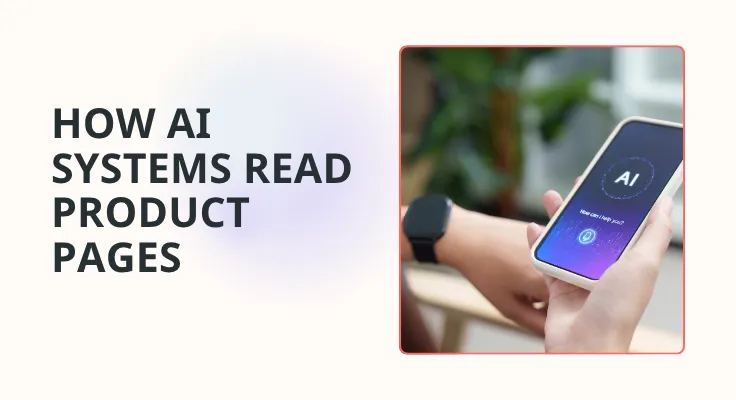
A growing share of your buyers no longer type “best running shoes under £100” into Google and click ten blue links. They ask ChatGPT to recommend one, compare options in Perplexity, or let Google’s AI Overview summarise the field before they ever touch a product page. With AI Overviews appearing on roughly half of all searches in 2025, assistant-led discovery has become a primary path to purchase.
That shift changes the job of your product page. It’s no longer only a page for humans to read; it’s a data source for machines to extract and quote. And here’s the uncomfortable part: the most important page in commerce is also the least legible to AI. If you understand how these systems actually read your pages, you can fix that. This guide walks through it.
From ranking to being quoted
The first mental shift: AI search engines don’t rank pages; they cite content. The goal moves from getting clicked to getting quoted. AI Overviews, ChatGPT Search, and Perplexity each assemble an answer from sources they can understand, and they decide which stores to cite based on how easily they can extract clean facts from your pages.
Critically, both Google’s AI Overviews and ChatGPT prioritise extractability over authority alone. A page with low domain authority that answers a product question in a clear, structured paragraph will beat a high-authority page that buries the answer in marketing copy. The machine rewards clarity, not cleverness.
Shoppers describe situations, not keywords
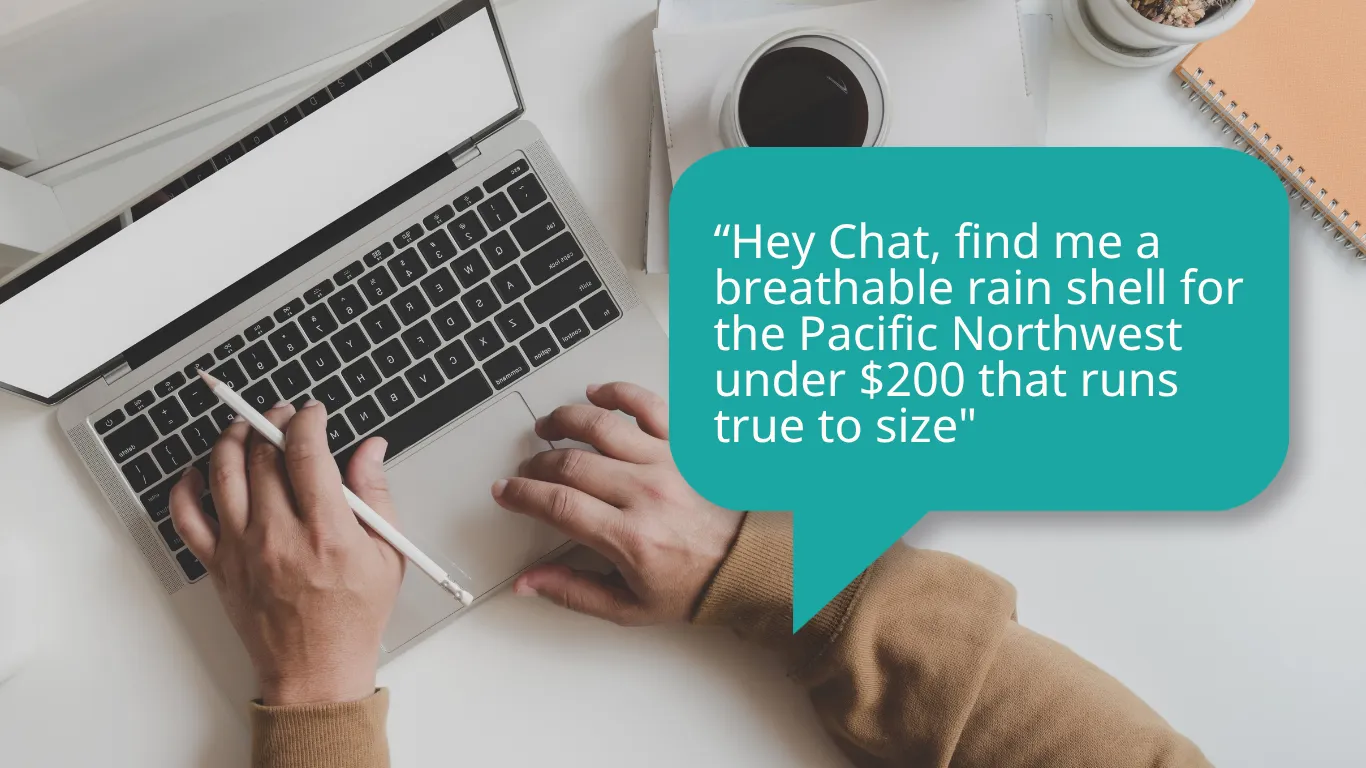
The way people search has changed too. A query typed into Google averages around four words; a prompt to ChatGPT averages closer to twenty-three! People no longer type keywords; they describe a whole situation and expect a recommendation back. “A breathable rain shell for the Pacific Northwest under two hundred dollars that runs true to size” is a completely different request from “rain jacket,” and it rewards a completely different kind of product data.
This means your page has to contain the specific attributes that answer those situational queries: material, use case, fit, price band, compatibility. Vague benefit copy like “premium quality, built to last” doesn’t get cited. Specific product facts do.
What AI actually looks for on a product page
When an AI system reads your product page, it’s trying to reduce its interpretive work to near zero. Here are the signals that help it most:
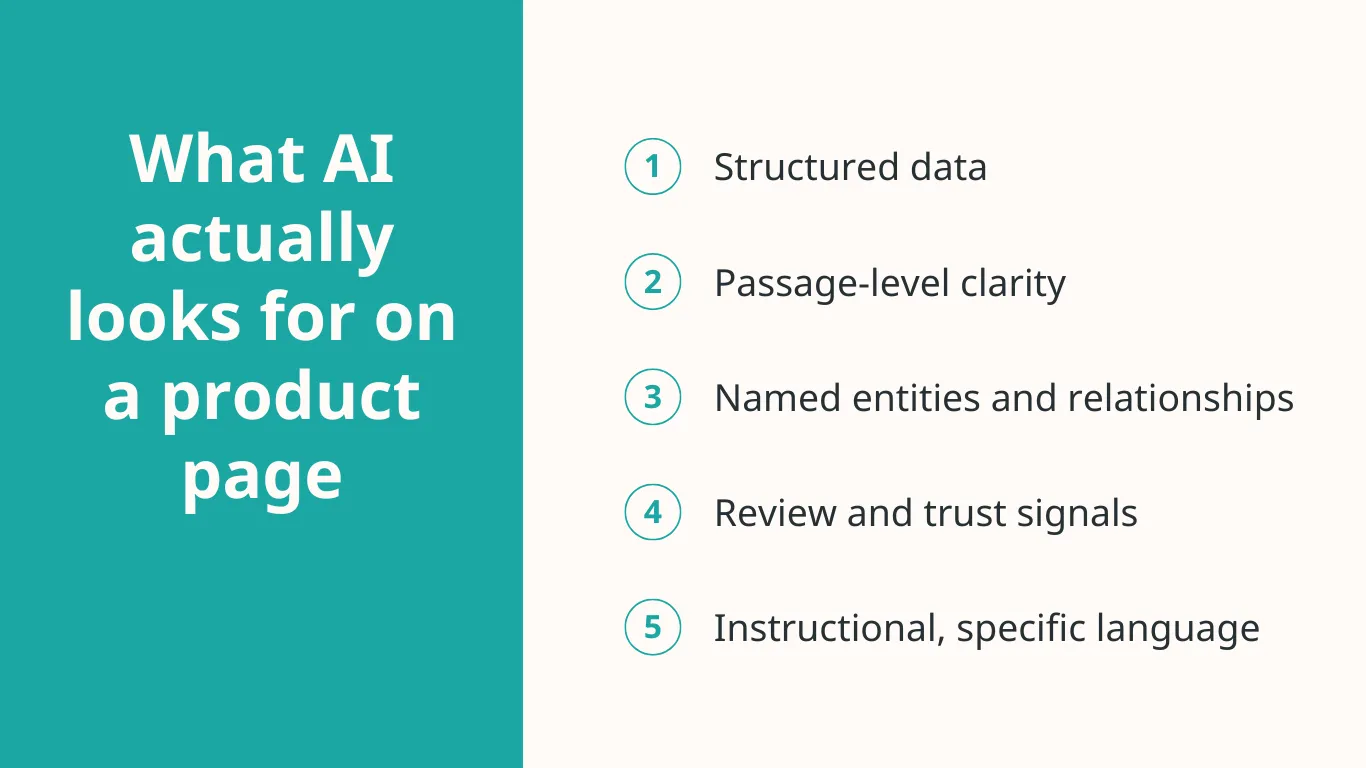
- Structured data (the single biggest lever). Schema.org markup in JSON-LD describes your content in a machine-readable format, defining who or what an entity is (brand, product), what type of content a page is, and how things relate. For e-commerce, prioritise a core stack: Organization, WebSite/WebPage, Product, Article, FAQPage/QAPage, and Breadcrumb before experimenting with niche types. Product schema with price, availability, reviews, and attributes is the most direct way to feed AI the facts it needs.
- Passage-level clarity. Google’s AI Overviews disproportionately favour pages where the answer appears in the first 100 words of a section, sits under a descriptive header, and includes at least one concrete fact (a number, a named attribute, a specific material or spec). Structure each section so the answer comes first, and the elaboration follows.
- Named entities and relationships. AI needs to understand that this product is made by this brand, belongs to this category, and is reviewed by these customers. Explicit entities and relationships (reinforced by schema) beat free text the model has to interpret.
- Review and trust signals. AI assistants assemble recommendations from structured data, review signals, and editorial coverage they can verify. Real, specific reviews give the model evidence to cite when a shopper asks “is this good for X?”
- Instructional, specific language. ChatGPT tends to cite sources that use first and second-person instructional language and that state concrete facts plainly.
Why most product pages fail the test
Product detail pages are the most numerous pages in commerce and the least optimised for machine reading. They’re typically built for human browsing: a hero image, a short benefit line, a price, and a buy button, with the actual specifications hidden in a collapsed tab or, worse, baked into an image the AI can’t read. The result is a page that converts a human who’s already there but is invisible to the AI deciding whether to recommend you in the first place.
A practical checklist to make your pages AI-legible
- Add Product schema with full attributes: price, currency, availability, brand, GTIN/SKU, material, and aggregateRating
- Add an FAQ section with real buyer questions, marked up as FAQPage. This captures the situational, conversational queries shoppers now ask assistants
- Lead each section with the answer. Put the concrete fact in the first sentence, under a descriptive header
- Replace vague copy with specifics. Swap “built to last” for the actual material, dimensions, and warranty
- Get specs out of images and into text. Anything trapped in a graphic is invisible to most AI systems
- Build topical depth. AI engines weight topical authority heavily, so cluster related content (guides, comparisons, FAQs) around your products rather than optimising single pages in isolation
- Reinforce E-E-A-T. Experience, expertise, authoritativeness, and trustworthiness: author credentials, publish dates, and brand mentions across the web all feed AI trust.
The bottom line
AI has raised the bar for product pages. The pages that win recommendations are the ones that give the machine clean, structured, specific facts with the least possible effort. Everything that makes a page legible to AI also makes it clearer and more trustworthy for humans, so this isn’t a separate workstream from good UX; it’s the same work, done well.
Want to know whether AI systems can actually read your product pages? , and we’ll check your structured data, page clarity, and AI-readiness alongside your conversion fundamentals.