SEO vs CRO: Which Should You Fix First?
By Emma Pugsley, Co-founder ·
If you run a small e-commerce store, your time and budget are finite, and “do both” isn’t a real answer when you can only afford to do one thing well this quarter. So let’s settle the SEO vs CRO question properly, not by declaring a winner, but by giving you a decision rule you can actually apply to your store this week.
First, the distinction that matters
SEO (search engine optimization) improves acquisition. That’s your visibility in organic search and the quality of traffic arriving on your site. CRO (conversion rate optimization) improves outcomes. That’s the percentage of those visitors who actually buy. One works before the visitor lands; the other works after.
They’re not rivals; you can’t really have one without the other. Rankings without conversions waste opportunity, and conversions without traffic leave potential untapped. But sequencing still matters when resources are tight.
Side-by-side
| SEO | CRO | |
|---|---|---|
| Goal | More qualified traffic | More conversions from existing traffic |
| Works | Before the visit | After the visit |
| Levers | Keywords, content, technical health, authority | Page clarity, friction reduction, trust, testing |
| Time to impact | Slow, takes months to compound | Faster, improves what you already have |
| Risk if ignored | Traffic stays flat | Traffic leaves before it converts |
The key practical difference: CRO can deliver faster improvements because it optimizes assets you already have, rather than waiting for rankings to climb.
✅ The decision rule: follow your bottleneck
The honest answer to “which first?” depends on where your store is losing money right now. Diagnose your bottleneck before you pick a lever.
Fix SEO first when:
- Your store has limited organic visibility and thin or outdated content
- You rely heavily on paid traffic to generate sales
- You operate in competitive, high-intent search categories.
In these cases, there simply isn’t enough qualified traffic for CRO to act on. Optimizing a checkout that 200 monthly visitors see won’t move revenue. Build the traffic engine first (SEO traffic tends to convert better than paid anyway, around 2.4% versus 1.3% for paid search).
Fix CRO first when:
- You already have steady traffic, but low conversions
- Visitors drop off on forms, product pages, or checkout
- Mobile conversion is weak, or your offer is good, but the messaging isn’t clear.
If you have traffic and it isn’t converting, more traffic just means a bigger leak. CRO plugs the hole and lifts revenue from the visitors you’ve already paid to acquire.
A simple traffic-vs-conversion grid
The cleanest way to prioritise is to plot your top pages on two axes — traffic and conversion rate:
- High traffic, low conversion → CRO first. These pages are your fastest wins. Small design and clarity tweaks yield large revenue gains because the audience is already there
- High conversion, low traffic → SEO first. These pages already sell; they just need more qualified eyes. This is where SEO investment compounds
- Low traffic, low conversion → reconsider the page (or the product) before investing in either
- High traffic, high conversion → protect and scale.
This grid turns an abstract debate into a per-page worklist, which is exactly how we approach audits at you x you i.
The real answer: sequence, don’t silo
For years, SEO and CRO lived in separate silos, and in 2026, that separation is no longer viable. The strongest approach is CRO-informed SEO: set traffic targets based on the conversion rates your page templates actually achieve, so you’re not driving visitors to pages that can’t convert them. If you invest in one without the other, growth becomes unstable.
So the practical sequence for most SMB stores:
- Diagnose the bottleneck: traffic problem or conversion problem?
- Fix the binding constraint first (usually CRO if you already have traffic, SEO if you don’t)
- Loop the other in as soon as the first shows results.
Not sure which is your bottleneck?
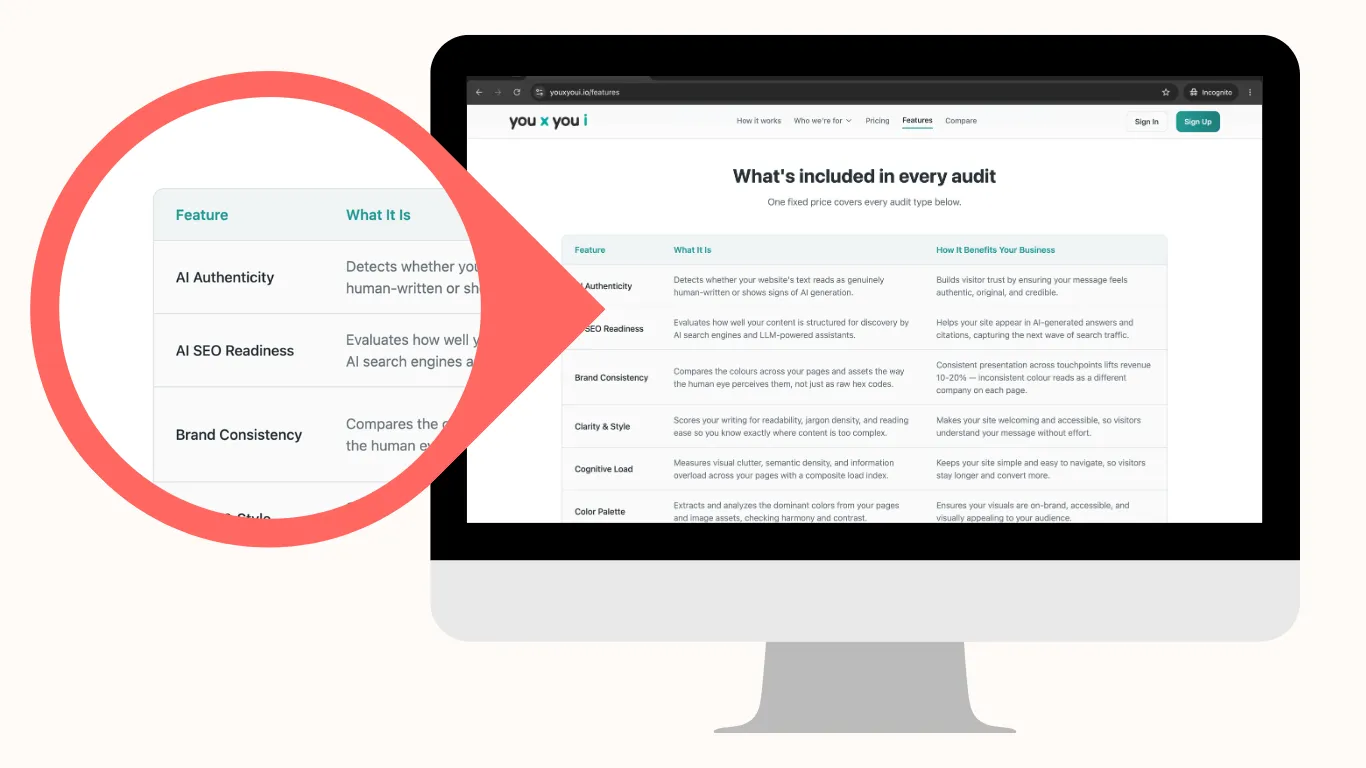
The hardest part is the honest diagnosis; most founders guess wrong because they look at the metric they enjoy rather than the one that’s struggling. Compare audit features to see how you x you i pinpoints whether your store needs more traffic or better conversion before you spend a penny fixing the wrong thing.
Related reading: E-commerce Conversion Rate Optimization